

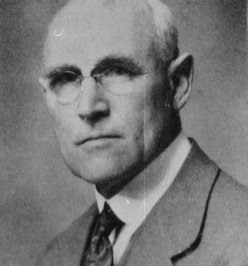


Sampson’s First World War Memorials
Sampson designed two separate war memorials - one to record the fallen (the town memorial in the churchyard) and the other to assist servicemen returning from the front (the War Memorial Club, now renamed the 1922 Club).
A temporary war memorial was established after the war on the Three Cornered Plot whilst ideas for a permanent monument were formulated. Robert Sampson put forward a suggestion that a Celtic cross should be erected in the churchyard. His first sketch was published in the Sidmouth Herald on 24th May 1919 and showed the memorial located alongside the church tower, to the right of the church entrance.
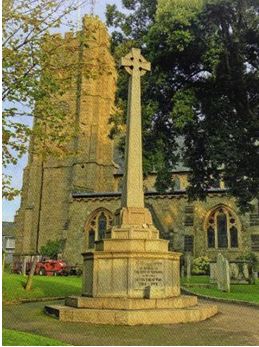
Although a different location in the churchyard was eventually chosen, Sampson’s original design was maintained. The completed memorial occupies a far more prominent site than originally intended, very much a focal point when viewed from Church Street.
It was almost 2 years before the memorial was erected. In reporting the unveiling ceremony on 20th February 1921, the Sidmouth Herald remarked that the monument comprised “…a magnificent granite column on a most substantial base, from designs prepared by Mr. Sampson, carried out by Messrs. Easton & Co of Exeter”.
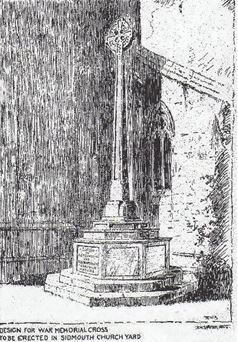
Sampson’s first sketch for the war memorial (left) and the memorial today (below).
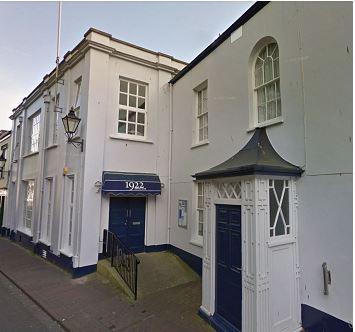
The 1922 Club, originally called the War Memorial Club, was established after the first world war to assist servicemen returning from the front. The declared purpose of the club was “…to keep alive and cultivate the spirit of patriotic comradeship to which the country largely owes its recent salvation”. The site chosen for the club was a building known as the Retreat, located opposite the parish church. The Retreat was built about 1825 and had been used as a residence for curates of the parish church during the 1850’s. The author Stephen Reynolds had lived there at the time of his death in February 1919.
There was a great deal of fund raising to get the scheme off the ground and eventually the existing building was acquired in 1920 for £1,000. Sampson was asked to prepare plans to create the club by designing an extension in the extensive yard areas adjacent to the building. The Sidmouth Herald joined the fund raising campaign and published Sampson’s first sketch proposals on 20th March 1920. Sampson’s extensions to the existing building were to include reading, recreation and billiard rooms. The extensions were to cost a further £478.
The opening ceremony took place on 22nd June 1922 (hence the present name of the 1922 Club). In offering opening remarks at the ceremony, William Hastings said “great praise was due to Mr. R. W. Sampson for the splendid work he has done in connection with the alterations to the building and the interest he has taken in the matter”.
The club was formally opened by General Sir John Hart Dunne. He had joined the army at the age of 16 in 1852 and his military career lasted 50 years until his retirement in 1902. On his retirement he moved to Sidmouth and lived at 6 Fortfield Terrace. He was greatly respected locally and thus was the natural candidate to open the club. He was presented with a ceremonial silver key, which is now held in its original presentation box in the Sidmouth Museum.
In his distinguished military career, Hart Dunne served in a number of conflicts from the Crimean War onwards. However, he is probably best remembered for his actions in the 2nd Opium War against China, and the events that followed. During the conflict the Summer Palace was plundered and various treasures together with 5 lapdogs were stolen. The Pekinese dogs were brought back to Britain, and Dunne presented one of dogs, which was given the name Looty, to Queen Victoria. The Queen evidently adored the dog, so much so the she commissioned a portrait of Looty and provided a copy of the painting to Hart Dunne. As a result of these events Hart Dunne is widely credited with introducing the Pekinese breed of dog to Britain.
Sampson’s preliminary sketch for the club shows a rather grand design for the building. It featured a Venetian window set in a gable facing Church Street and towers surmounted with cupolas were to define each corner of the building. In the event, this elaborate detailing was omitted, probably as a result of economy measures. The completed building is more restrained in character, incorporating a single eaves line with a simple parapet wall detail.
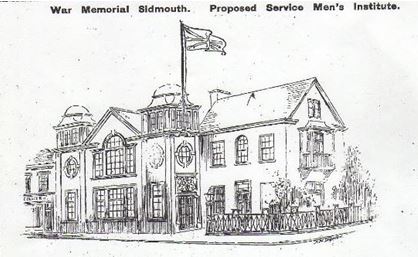
Sampson’s first sketch for the War Memorial Club (left) and the Club today (below).
Internally, there has been some rearrangement of the layout envisaged by Sampson. The present main bar area was originally conceived as a reading and recreation room and was slightly smaller, having been extended into an area previously intended for a scullery and coal house. The internal walls at ground floor level in the original building have been removed to create a second bar area, rather than a writing room and ancillary accommodation.
Sampson originally intended a dog-leg design for the stairs, with the first floor landing located above the entrance hall. Thus the entrance to the billiard room above the main bar would have been at the front of the property rather than the rear. However, the size of the billiard room itself is unchanged from Sampson’s plans, which show two tables, as in the present arrangement. Sampson proposed a further writing room on the first floor of the original building, but this area now included in the steward’s accommodation.
The building has seen a number of alterations over the years and it is likely that some internal features designed by Sampson have been lost. For example it is almost certain that the building would have been heated by a number of open fires, but no evidence of any of the fireplaces can now be seen.
The two memorials are both classed as listed buildings because of their architectural or historic interest. The formal listing description for the town memorial states that it was designed by Robert William Sampson, describing him as a prominent local architect. Sampson is not referred to in the listing entry for the club, as the qualification for listing relies more on the age of the original building rather than Sampson’s extension.
Martin Mallinson
July 2022